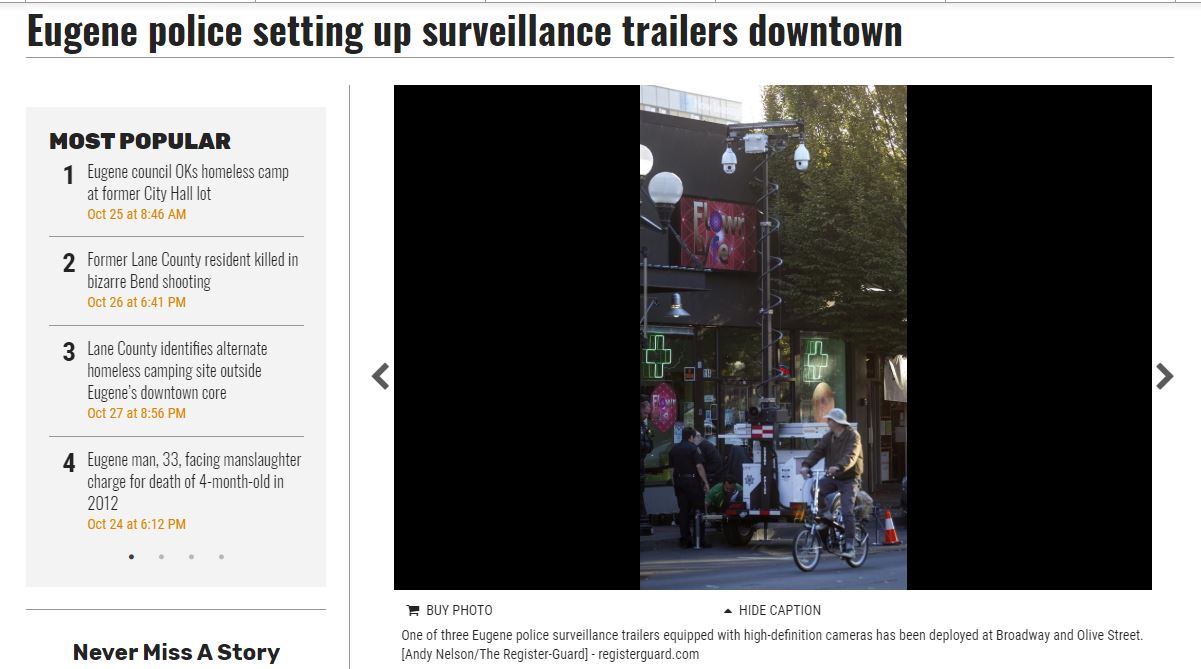
Three Eugene police surveillance trailers are keeping watch on areas of downtown.
The trailers; loaded with high-definition cameras; were set to debut at Kesey Square on the intersection of Broadway and
Willamette Street, at Broadway and Olive Street, and in the Park Blocks at Eighth Avenue and Oak Street, Eugene Police Chief
Chris Skinner said Friday.
“We think that gives us the best opportunity for the public to get used to seeing these, he said. It gives us
the best opportunity for people to know that this is going to be a part of the landscape.
The three trailers cost Eugene police a combined $152,000, according to the department. Each trailer holds three high-definition
cameras that have infrared capabilities for recording at night. Police will be able to control the cameras with smartphones
or tablets.
Initially, police wont be monitoring live video from the trailers, said Melinda McLaughlin, Eugene police spokeswoman.
Instead, officers will be able to check footage recorded by computers linked to the cameras. The trailers can record sound,
she added, but police dont plan to listen for now they only plan to review video if needed.
The whole point of this is not trying to sneak up on people, as you can tell, Skinner said. They are (marked with decals)
and branded and marketed to be Eugene Police Department is in the area. We care about your safety. Were going to keep an eye
on things for you. And thats exactly the message we are trying to send to people.
Police will move and set up the trailers at special events, crime scenes and elsewhere around the city, Eugene police
Lt. Doug Mozan said. We have the versatility to pull these just about anywhere we need, he said.
On Friday, September 9th, people across Portland and Northwest will converge in Downtown Portland in solidarity with the US
wide prison work strike against prison slavery and white supremacy. Our goal is a mass showing of support with the growing
prison rebellion in the US and to also march on the corporations in the Downtown area that make massive profits off of prisoner
enslavement.
The strike, which starts officially on September 9th, the 45th anniversary of the Attica Uprising, is historic. The strike
is being led by groups such as the Free Alabama Movement, Free Texas Movement, Free Ohio Movement, Free Virginia Movement,
Free Mississippi Movement, and many more. Prisoners have asked that supporters hold noise demonstrations outside jails and
prisons, protest, disrupt, and demonstrate outside of corporations that profit from prison labor, and also support the strike
that is happening across the US. https://youtu.be/8pnnc9w_NrM
Filmed at Madison High School on Feb 22 2016
This conversation event is open to the public and consists of citizens and police and a panel led discussion. https://youtu.be/NGyoJ1zbrSA
1.13.16
Use of Force Training - Portland Police 2016
Citizen Training Advisory Work Group in Portland Oregon hears about the "Use of Force Training program" by the Portland Police.
https://youtu.be/T_0jolZA0CE
3.23.16
Policestate at Rose Garden
Fare check gate is set up At the Rose Garden / Moda center. As we pull up I see 3 police cars and then later by the platform
I see more cops standing around watching. This was 3/23/16 at 6:04pm - Moda Center MAX stop. Folks getting off the Max are
funneled thru a "Fare Check" gate.
https://youtu.be/7gS9XKi2SZM
3.23.16
Trimet gateway so many police cars
Lots of cop cars at Gateway Transit Center on 3.23.16 around 6:15 PM. A few cops appear as I walk back by.
https://youtu.be/7nncy89ubsA
4.1.16
Protesting the Citizens Crime Commission Fundraiser in Portland
The Citizens Crime Commission, which recently appointed former Portland
Police Chief Mike Reese as its executive director, is holding on 4.1.16 a charity
event for $1000 per person which focuses on violent police tactics. While
the non-profit talks about wanting to "improve civility and strengthen
crime," the invitation-only event "Meet the Heat" reads more like an
invitation to fetishize cops and robbers mentality.
https://youtu.be/A6TKk19XMOo
Man in Green {jacket} in this video, [after being released]
tells me somebody reported him ....
as a person that was threatening people in the park.
When in fact he was "the victim" and was threatened by
"a man with a knife" in the South Park Blocks
https://youtu.be/8TWpWvDoUwk
Homeless Crime Victim Harassed by the Portland Cops
I was with Film The Police Bob (FTP) around Overlook park around 9am when we seen a cop car pull into the park, we walked
over to see what they were up to. The homeless lady in the park said that the cops left when they seen us two walking up,
she also told us about a lot of crappy things that were going on and how mistreated she felt over a variety of failing systems
and services. The police hassling folks like her is not warranted nor needed. https://youtu.be/XeBAVGD0Gcc
9.29.15
Cops Stop Wrong Guy at Gateway Tri-Met
The police pull up and get out of their unmarked car, to detain a young man at Gateway Transit Center. They look over their
"wanted flyers" and then "run his name" ...only to my amazement he is not the guy they wanted. https://youtu.be/YiveND07Oic
9.16.15
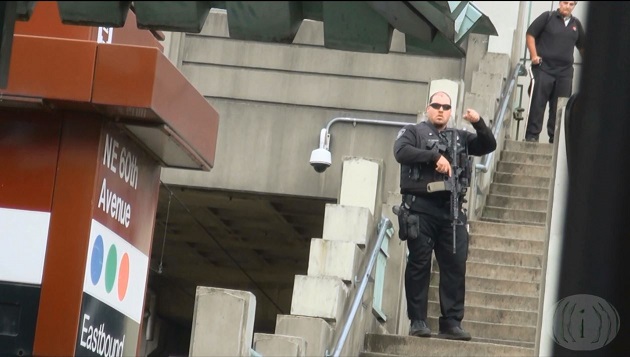
Cops swarm Tri Met Max Platform - False Alarm There Was No Gun
6 cops swarmed onto the Max platform and had their guns / tazers out on a man who they "thought had a gun" ... The man had
a cell phone and there was no gun. https://youtu.be/McL3ePQ7HIg
Cops Swarm Tri Met Max Platform - False Alarm Ther
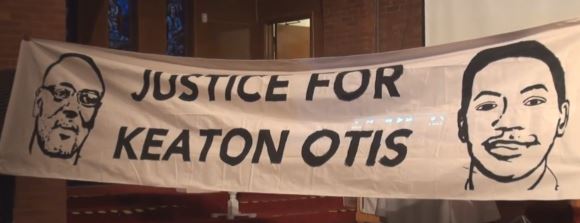
Since his homicide by Portland police, the community monthly held a vigil at the site
of the killing, demanding Justice for Keaton Otis. https://youtu.be/wlmwgXf0LGA
undefined
http://keatonotisshot23times.blogspot.com/
11.25.14
Ferguson Solidarity Protests
in Portland Oregon
All my video footage is on
this YouTube Playlist here:
http://tiny.cc/ib65px
VIDEO:Ferguson Solidarity Portland Police Officer Fun Boy
Officer
Fender who was called "Officer Fun Boy" earlier in the video, pushes me back with his baton as he tells me to move back. I
was already on the sidewalk and did not appreciate the interaction in this abusive disrespectful manner. This type of interaction
and abuse of power and weapons on unarmed citizens / journalists is illegal and un-called for. http://youtu.be/HavZLwVbssk
VIDEO: Ferguson Solidarity: Not Guilty 11.25.14. out-take. 2 Arrested in Portland Oregon -
After a long march through NE SW and NW PDX in the streets (The 2nd) Ferguson Solidarity march (Not the AMA march) was in
front of PGE park on the sidewalks and spilling into the street when this video was taken. Portland Cops arrest 2 protesters
at Ferguson Solidarity march on Tuesday night.
Not sure why these 2 people were "snatched" or singled out.
The bike police casually sneak along the side to bum rush the crowd.
The protesters apparently had ended their march and were standing around for about 20 minutes.
Around 8:30 PM a gang of Cops On Bikes slide in from north side and snatch / attack the protesters - 2 arrested.
Knuckle Head: Portland: copwatching
an arrest on 10th ave.
I arrive when a man is being
stuffed into the police car. I was informed by a witness that said the "transit" police arrived and immediately called
out to the suspect as "Hey Knuckle Head".
After the arrest police sergeant, asks me for my name, what I saw and for
a copy of the video [or] a way to download it. I inform her that I am filming for police accountability, and when asked
for my name I would rather not give it up
100
people gathered in Holladay Park on Labor Day 8.1.14 in Portland Oregon in SOLIDARITY! with Ferguson Mo.
The march went across the street (in the street), then through the biggest indoor mall on the West
coast (Lloyd Center) and then back into the streets, (NE Broadway) blocking the entire street with no police in sight (thus
no violence) the 100 people walked toward the Broadway bridge, at 2:30 pm in solidarity w/ the request fro thos in Ferguson
the group stopped and blocked traffic. Although talk was to 'head to the bridge' a quick change in plan resulted in the "freeway
on-ramp going north to I-5 was shut down by a "Sit-In" for about 10 minutes".
Police
shooting a young unarmed man in Ferguson Missouri and the treatment of the community who rose up in protest over the killing
has caused national attention and outrage. Citizens of Portland Oregon gather in the park, out of concern for police accountability
and community safety. The stood in unity and in Solidarity with the community of Ferguson Missouri in public... to demand
and end to police violence and the abuse of their authority leveraged on the people they were sworn to protect and serve.
This gathering was open to anybody who wanted to speak. The rally started slowly and eventually grew in size with over 100
people. There is a Facebook page "Stop Don't Shoot Portland" and there will be an email list anybody can join to stay in contact
and to unite. [more info and links forthcoming asap]
Portland Solidarity w Ferguson Community -
Pioneer Square
Police shooting a young unarmed
man in Ferguson Missouri and the treatment of the community who rose up in protest over the killing has caused national attention
and outrage. In Portland Oregon a couple hundred gather in Pioneer Square.
LONG-TIME POLICE
ACCOUNTABILITY GROUP DENIED MEETING WITH MAYOR
Portland Copwatch, an
organization promoting police accountability since 1992, has been denied a
meeting with Mayor/Police Commissioner Charlie Hales after three months of
back-and-forth with his scheduler and police liaison. Although the group has
met with every Chief and Mayor since its creation, the current Commissioner
seems to be shutting out the organization, after meeting with them a year
ago on July 22, 2013.
Causing pain to a person in need, while sent to help them, is wrong!
Filmed on June 5 2014 in Portland Oregon on SW 10th & Salmon The man needed help ....this
is not the right type of help to provide to a person passed out on a sidewalk, the pain tactics used to move this man on the
ground to the van, by the Chier's employee were uncalled for and not necessary. A stretcher to roll the person who was unconscious
or passed out on, and then lifting them into the van would be more prudent, human and dignified. Hurting a person who is non
violent is not appropriate. Its a violation of this mans rights.
Film The Police Portland is a grassroots, volunteer-run organization that focuses on
police accountability through filming police encounters in the community.
We
intend to achieve our goals by growing our numbers of video activists so we can cover the entire downtown area of Portland
Oregon!
"Power Tripping Cop Scared of A Camera"
These cops need training - Very Piss Poor Attitude by these Police (Portland Parole Officers - Sherriff's) - The Whole World
Is Watching how they act in Portland Oregon - filmed in April 2014
[quote] We, the people, urge everyone to take action
against this sort of abuse and to put an end to this decline toward a police state. We ask you to videotape and record the
police during their daily duties. If you see an officer issuing a parking ticket, record him. If you see an officer holding
a victim at gun point, record him. If you see an officer harassing a fellow protester, record him. The police watch us with
dash mounted cameras, street cameras, red light cameras and even remote mobile cameras. It's time the watchers become watched.
It's time the abusers are held accountable. As the authorities say of us; "If you have nothing to hide, you have nothing to
fear.".
This is the first that I have seen
of a vehicle like this, used by the park rangers, in Portland Oregon. A city park ranger is riding on a 3 wheel (scooter)
in the south west park blocks in June 2013 http://youtu.be/n17CqlfxwSc
6.8.13
Pitch A Tent Rose
Festival Protest 2013 - Joe Anybody & Radical Richard Copwatching
2013 Rose Festival Parade - Pitch A Tent Protest
on 4th street highlighting the injustice of sidewalk laws that impact houseless people and their civil and human rights. Also
there is some Copwatching being done by Joe Anybody and Radical Richard around this area. http://youtu.be/-BkVQ2h6k0I
6.13.13
Police Horse Shit at Lunch Time
By Meals on Wheels
The poor horse had to go - trouble is the cops leave this shit all over town - this was filmed around lunch time
in front of Meals on Wheels on SW 12th street in downtown Portland. Retire the Horses to pastures and clean up your mess in
the mean time. http://youtu.be/X3bO8Sy1MIg
Unpermitted March does not mean the police can now
hurt the people for public safety. This is a video with clips taken from the
recent 2.14.13 unpermitted One Billion Rising March, recently in Portland in
which the police treated peacefully the unpermitted marchers *this time.In
contrast:There is out-takes added from May Day 2012 and from the N3 Austerity
march in 2012 that were both unpermitted marches... where folks who were
protesting were then pepersprayed, blocked and tackled by the police. [while in
the street trying to march]
Unpermitted
Does Not Mean Police Can Hurt People 2013 Portland Oregon
Unpermitted
March does not mean the police can now hurt the people for public safety.
This is
a video with clips taken from the recent 2.14.13 unpermitted One Billion Rising March, recently in Portland in which the police
treated peacefully the unpermitted marchers *this time.
In
contrast: There is out-takes added from May Day 2012 and from the N3 Austerity march in 2012 that were both unpermitted marches...
where folks who were protesting were then pepersprayed, blocked and tackled by the police. [while in the street trying to
march]
There is also a short out-takes from 2008 when
the police took my camera, whereupon I filed a lawsuit and changed the policy regarding filming the police in public [and]
I got my camera back, [plus $3,000 in lawyer fees and a tiny token 100 bucks for my personal fee]
The point of this video is to highlight the peaceful marches and the ones where their has been a (uncalled
for) call for violence orchestrated by the police, which usually always is justified by them, by using words like; public
safety, and anarchist [?] being involved, [etc.] The video from Veterans Day highlights the "A" word concern expressed by
Officer Friendly (inches from my face) The police were there, for the possible Veterans "unpermitted march" {that didn't happen]
"As the popularity of text messages has exploded in recent years, so has their use
in criminal investigations and civil lawsuits. They have been introduced as evidence in armed robbery, cocaine distribution,
and wire fraud prosecutions. In one 2009 case in Michigan, wireless provider SkyTel turned over the contents of 626,638 SMS
messages, a figure described by a federal judge as 'staggering.' Chuck DeWitt, a spokesman for the Major Cities Chiefs Police
Association, which represents the 63 largest U.S. police forces including New York City, Los Angeles, Miami, and Chicago,
said 'all such records should be retained for two years.' Some providers, like Verizon, retain the contents of SMS messages
for a brief period of time, while others like T-Mobile do not store them at all. Along with the police association, other
law enforcement groups making the request to the Senate include the National District Attorneys' Association, the National
Sheriffs' Association, and the Association of State Criminal Investigative Agencies, DeWitt said."
The U.S. Supreme Court on Monday declined to hear an appeal of a controversial
Illinois law prohibiting people from recording police officers on the job.
By passing on the issue, the justices left in place a federal appeals court ruling
that found that the state's anti-eavesdropping law violates free-speech rights when used against people who audiotape police
officers.
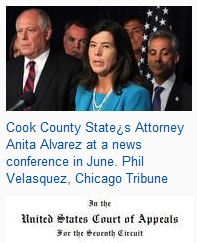
A temporary injunction issued after that June ruling effectively bars Cook County
State's Attorney Anita Alvarez from prosecuting anyone under the current statute. On Monday, the American Civil Liberties
Union, which brought the lawsuit against Alvarez, asked a federal judge hearing the case to make the injunction permanent,
said Harvey Grossman, legal director of the ACLU of Illinois.
Grossman said he expected that a permanent injunction would set a precedent across
Illinois that effectively cripples enforcement of the law.
Alvarez's office will be given a deadline to respond to the ACLU request, but
on Monday, Sally Daly, a spokeswoman for Alvarez, said a high court ruling in the case could have provided "prosecutors across
Illinois with legal clarification and guidance with respect to the constitutionality and enforcement" of the statute.
Illinois' eavesdropping law is one of the harshest in the country, making audio
recording of a law enforcement officer — even while on duty and in public — a felony punishable by up to 15 years
in prison.
Public debate over the law had been simmering since last year. In August 2011,
a Cook County jury acquitted a woman who had been charged with recording Chicago police internal affairs investigators she
believed were trying to dissuade her from filing a sexual harassment complaint against a patrol officer.
Judges in Cook and Crawford counties later declared the law unconstitutional,
and the McLean County state's attorney cited flaws in the law when he dropped charges in February against a man accused of
recording an officer during a traffic stop.
Alvarez argued that allowing the recording of police would discourage civilians
from speaking candidly to officers and could cause problems securing crime scenes or conducting sensitive investigations.
But a federal appeals panel ruled that the law "restricts far more speech than
necessary to protect legitimate privacy interests."
Chicago police Superintendent Garry McCarthy has said he would favor a change
allowing citizens to tape the police and vice versa.
Meanwhile, several efforts to amend the statute in Springfield have stalled in
committee amid heavy lobbying from law enforcement groups in favor of the current law.
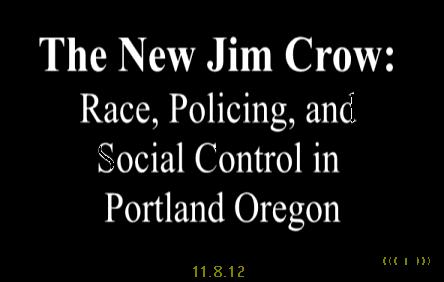
The New Jim Crow Race Policing Social Control in Portland
Community leaders will discuss issues ranging from the scathing Department of
Justice review of the Portland Police Bureau, Police violations of civil liberties, and the stereotyping of Black youth and
offer solutions to these problems. http://youtu.be/IEwG6mFwjrU
The Very next day I was home invaded. Illegally they have no warrant as you see by the
video. I had just left hospital day before this and the police warned me to remove the videos I posted from them brutally
assaulting me and I lost my spleen and other assorted guts to police brutality. I posted the videos and was then warned to
take them down or else. Again the very next day they broke in my home illegally and Assaulted me as you see by this video.
I'll take a lie detector test to confirm what you already know is true. Coral Springs Police are as corrupt as any other police
force you have an encounter with. Many police encounters are deadly. I almost dies at the hands of coral springs police and
also their fire rescue paramedics. All are sick and sadistic and care nothing about you, your family, your home or your lives.
They care not if you die in their care... It's become very sick in these times your aware now of the truth. This video is
one that survived the police deleting. They beat me in cuffs and deleted as many videos as they cared to delete. They left
behind a few and I've posted them. The truth hurts. Be well people pass on love today!
Message to All Police Officers
From a Police Officer Occupy Wall Street
Police Accountability & statnding in Solidarity with Ananiem Ca!
Portland - over 150 people march in solidarity with the citizens being abused
by Anaheim police and to call for Portland Polce to be accountable and to respect the community and all the many races and
cultures in our city. We want justice and we want peace in our communities, not violence and opression by those who should
be "protecting and serving" our communities.
Last week 4/2012 the City of Boston agreed to pay Simon Glik $170,000 in damages and legal
fees to settle a civil rights lawsuit stemming from his 2007 felony arrest for videotaping police roughing up a suspect. Prior
to the settlement, the First Circuit Court of Appeals unanimously ruled that Glik had a "constitutionally protected right
to videotape police carrying out their duties in public." The Boston Police Department now explicitly instructs its officers
not to arrest citizens openly recording them in public.
Slowly but surely the courts are recognizing that recording on-duty police is a protected
First Amendment activity. But in the meantime, police around the country continue to intimidate and arrest citizens for doing
just that. So if you're an aspiring cop watcher you must be uniquely prepared to deal with hostile cops.
If you choose to record the police you can reduce the risk of terrible legal consequences
and video loss by understanding your state's laws and carefully adhering to the following rules.
Know Your Rights ((( i ))) The Police and a Converstaions
with you Video training film for the citizen / police oversight committiee Presented by the Portland Police on 10.5.10
- open to the public. Worth watching!
Must reads for all of you wanting to videotape or take photos.
In the above video, a news videographer is standing on public property when approached by a cop who demands
his identification (starting at 1:40).
The videographer refuses to provide his identification on the grounds that he is not doing anything illegal.
The cop, of course, gets irritated and calls for more cops.
But the videographer continues to refuse. And he continues to film, much to the dismay of the cop who comically
places his hat in front of the lens.
Did the videographer have the legal right to refuse to provide ID?
Yes.
But only because he was not being lawfully detained (the key word being “lawfully” as the officer
did tell him he was being detained at 4:20).
After several minutes of bullying, the videographer was allowed to leave without producing his identification
because they really had no reasonable suspicion to detain him.
However, he was ordered to leave the area when it is clear from the video that other civilians are casually
strolling the same area. That was another unlawful order.
But at that point, he probably didn’t want to push his luck.
He was in Texas, after all.
Contrary to what some might believe, there is no federal law mandating that we must provide identification
when asked by police.
However, several states have “stop and identify” statutes that require people to produce identifications
if they are being legally detained. And police can only legally detain you if they have a reasonable suspicion you have committed
or are about to commit a crime.
Texas recently joined the ranks of states that have these statutes. And the following 24 states also have stop and identify
statutes, according to Wikipedia.
The Wikipedia entry breaks down police interactions into three categories; consensual, detention and arrest.
A consensual interaction is no different than an interaction between two civilians on the
street. It gives the cop the right to ask the civilian questions, but it also gives the right for the civilian to refuse to
answer those questions, including providing identification.
A detention interaction is where a person is being legally detained, meaning the officer
needs to have some sort of reasonable suspicion that the person is involved in a crime. This is generally known as a “Terry Stop.” In the states that have stop and identify laws, the person could be arrested for refusing to provide identification.
The arrest interaction is when police have probable cause to arrest a person, which requires
more evidence than mere reasonable suspicion. This, of course, allows the officer to search the person for identification
once the arrest is made. If the suspect does not have identification, it could be illegal to refuse to identify oneself depending
on the jurisdiction. You might remember last year’s article about a New Hampshire man who spent several weeks in jail for refusing to provide his real name.
Some police apologists might argue that if a person refuses to provide identification during a consensual
argument, then that automatically turns it into a detention interaction because it gives the cop reasonable suspicion that
he is trying to hide something.
But even an article written by a senior legal advisor from the Plano, Texas Police Department published in
The Police Chief, described as the “Professional Voice of Law Enforcement,” confirms that an officer must be engaged
in a Terry Stop before he can demand identification.
To further confound things, the rules supposedly differ when a person is operating a vehicle because state
laws usually require people to produce identification upon request.
But even that has been challenged by a couple of Arizonaactivists who were arrested after refusing to comply with authorities after having been stopped at Border Patrol check
points, including one who recently had his charges dismissed.
-30-
Take a couple of minutes and vote for Photography is Not a Crime
in the South Florida Sun-Sentinel Best of Blogs Awards contest. The main category is the Best Overall Blog category. That’s the grand prize.
I was also nominated for the “Politics” category, the “Art/DIY” category and the “Photography” category. You need to register to vote, but once you do, you can stuff the ballot box by voting for each category
at least once a day until the contest ends.
It only takes a couple of minutes. Think of all the time I spend
updating this damn blog. It would be well appreciated.
7.1.11
Joe Anybody Reports:
on Portland Police Accidental Beanbag Shotgun Shooting
When Dane Reister took my camera and ticketed me, I filed a tort claim and won. The city changed their policy to allow
the public to film the police in public. Wow! I had to fight for my right to film, which is my free speech. This officer reaction
to me or others that are watching him, is ugly and disturbing. So now that same officer shoots a 20 year old 4 times with
his beanbag [?] gun, BUT its loaded with real LIVE shotgun shells - This report is my opinion of officer Dane Reister.
The police say "Hi Joe" as they drive by me when leaving with the arrested (?) lady, the next cop waves to the camera
as he drives by. A related article about this same group of over zelous cops is posted here on indymedia http://youtu.be/X2pFW9zGS_E
Photographer arrested for just taking pictures at #OO protest.
Followed police orders to step back yet was still arrested. All these officers should be fired for infringing on people's
constitutional rights. This is a duplicate in case the original gets taken down.
(1) 1/3/11 Portland Anarchists marched 2 miles down the middle of the streets in Portland Oregon to show their
disgust and outrage over all the police shoots and murder. The police shoot people and deaths is rising. The 65 Anarchists
march past a bank and a couple of people leave their message on the front doors. The march continues, towards the police station
with a few dumpsters blocking the street and loud chants directed at the police for killing citizens.
(2) 1/3/11 The Anarchists are marching up NE 47th street to the NE police station, the police arrive behind
them in cars ordering them out of the streets. they continue chanting anti police violence chants and stay in the street.
A few re-cycle bins and garbage cans tossed in the street for the police to drive around. The march walks on sidewalk in front
of the police stations, chanting yelling and then disappears into the night... with 60 police all armed and standing around
the front of their building.
Faced with complaints from a citizen watchdog group, Atlanta police will stop interfering
with people who videotape officers performing their duties in public, an agreement reached with the city Thursday says.
The settlement, which also calls for the city to pay $40,000 in damages, requires city council approval.
The
agreement resolves a complaint filed by Marlon Kautz and Copwatch of East Atlanta, a group that films police activity with
cell phones and hand-held cameras. The group has volunteers who go out on patrols and begin videotaping police activity
when they come across it.
Last April, Kautz said, he pulled out his camera phone and began recording Atlanta police
who were arresting a suspect in Little Five Points. Two officers approached him and said he had no right to be filming
them, Kautz said. When Kautz refused to stop, one officer wrenched Kautz's arm behind his back and yanked the camera out
of his hands, he said. (read more)
This was a Community Oversight of Portland Police meeting that over 50 people attended. Most were there to tell how they
were treated by the police while participating in Occupy Portland march on January 25. Over a dozen people tell what happened
to them or what they seen that was inappropriate, unprofessional, unethical, and illegal. There is also testimony from other
police citizen related concerns. The meeting was in progress when I started taping so I missed the first 30 minute.
All new 2011 content will be posted at the top of this page. Not posted out of hatred or spite - posted to help
promote honest justice. Posted to provide transparency and accountabilityfor community